
If you play music in your business - whether it's a restaurant, retail store, salon, hotel, gym, or office - you need to understand the legal framework around commercial music use. This isn't about scaring you into compliance; it's about helping you make informed decisions that protect your business and support the creators behind the music you enjoy.
This guide covers the fundamentals of music rights for businesses, explains the different types of licenses that exist, and shows how modern solutions can make compliance effortless.
What Is "Public Performance" and Why Does It Matter?
The Legal Definition
In most jurisdictions around the world, playing music outside of a private, personal setting is considered a "public performance." This applies whether you're:
- Playing music through speakers in a restaurant
- Streaming a playlist in a retail store
- Running background music in a hotel lobby
- Playing music on hold for phone callers
- Streaming music at a fitness class
The key distinction is simple: if anyone other than your immediate family or close circle of friends can hear the music, it's likely a public performance. And public performances require authorization from the rights holders.
Why This Exists
Music copyright law is designed to ensure that the people who create music - songwriters, composers, performers, and producers - receive fair compensation when their work is used commercially. Just as you'd expect payment for your products or services, musicians deserve payment when their creative work enhances your business environment.
This is a fundamental principle that applies in virtually every country, though the specific rules and enforcement mechanisms vary by jurisdiction.
The Types of Rights Behind Every Song
Understanding music compliance starts with understanding that every recorded song involves multiple layers of rights, each owned by different parties:
1. Composition Rights (Musical Work)
These belong to the people who wrote the song - the songwriter(s) and composer(s). Composition rights cover:
- The melody
- The lyrics
- The harmonic structure
- The arrangement
These rights are typically managed by music publishers and, in many countries, by collecting societies that represent composers and authors.
2. Recording Rights (Sound Recording)
These belong to whoever recorded and produced the specific version of the song - typically the record label or the performing artist. Recording rights cover:
- The specific recorded performance
- The production and engineering
- The particular interpretation of the composition
These are separate from composition rights, which means a business often needs to obtain authorization for both the composition and the recording.
3. Performer Rights
In many jurisdictions, the musicians who performed on the recording - singers, instrumentalists, session musicians - also have separate rights. These may be managed by yet another organization.
What This Means for Your Business
If you want to play a commercially released song in your business, you potentially need authorization covering all three layers of rights. This is why traditional licensing can involve dealing with multiple organizations.
How Requirements Vary by Jurisdiction
One of the most important things to understand about music licensing is that rules differ significantly from country to country - and sometimes even between states or regions within a country.
Key Variables That Differ
A Global Business Needs Global Awareness
If you operate across multiple countries or are expanding internationally, be aware that music licensing compliance in one market doesn't automatically translate to another. Each jurisdiction may require separate licenses and have different organizations to deal with.
The Types of Licenses Available
Broadly speaking, there are several types of licenses relevant to businesses playing background music:
Blanket Licenses from Collecting Societies
The traditional approach is to obtain blanket licenses from collecting societies in your jurisdiction. A blanket license typically gives you the right to play any song in that organization's catalog for a set annual fee.
Pros:
- Access to a vast catalog of well-known commercial music
- Legally straightforward once obtained
Cons:
- You may need multiple blanket licenses (composition + recording + performer)
- Annual fees can be substantial, especially for larger businesses
- Administrative burden of managing multiple licenses
- Fees continue regardless of how much music you actually play
Direct Licenses from Rights Holders
Some businesses negotiate licenses directly with record labels, publishers, or individual artists. This is more common for specific uses (like a song in a commercial) than for general background music.
Pros:
- Can be customized to specific needs
- Direct relationship with content providers
Cons:
- Impractical for background music (you'd need thousands of individual deals)
- Time-consuming and expensive to negotiate
- Limited catalog per agreement
All-Inclusive Licensed Music Services
This is the modern approach that's transforming business music. Services like 4Play license music directly from artists and rights holders, then offer businesses a single subscription that includes both the music and the commercial license.
Pros:
- One subscription covers everything - music and all rights
- No separate licensing organizations to deal with
- No reporting requirements or compliance paperwork
- Professional business features (scheduling, multi-location, filtering)
- Significant cost savings vs. traditional approach
Cons:
- You play music from the service's curated catalog rather than any commercial song you want
- Artists are independent creators rather than mainstream chart-toppers (though quality is professional-grade)
Common Compliance Mistakes Businesses Make
Mistake 1: Assuming a Streaming Subscription Is Enough
This is by far the most common mistake. Consumer streaming services like Spotify, Apple Music, and YouTube Music are licensed for personal use only. Their terms of service explicitly prohibit commercial use. Having a premium subscription does not give you the right to play music in a business setting.
Even if you pay for the streaming service, you'd still need separate commercial licenses from collecting societies - making this the most expensive approach overall.
Mistake 2: Thinking Small Businesses Are Exempt
While some jurisdictions offer limited exemptions for very small establishments, these exemptions are far narrower than most people think. In many places, even a small café with a single speaker needs a license. Don't assume you're exempt - verify based on your specific jurisdiction and business type.
Mistake 3: Believing "No One Will Notice"
Rights organizations in many countries actively monitor businesses for compliance. This can take the form of:
- Physical inspections where representatives visit businesses
- Digital monitoring of streaming and playback
- Responding to anonymous tips
- Systematic audits of businesses in specific sectors
Getting caught typically results in not just current fees, but retroactive charges for the period of non-compliance - which can go back several years.
Mistake 4: Not Understanding What "Royalty-Free" Means
"Royalty-free" is often misunderstood. It doesn't mean "free music" or "no rights involved." It means the licensing model doesn't require per-play royalty payments. Someone still created the music and needs to be compensated - the payment structure is just different (typically a subscription or one-time fee rather than ongoing per-play charges).
Mistake 5: Ignoring Jurisdiction Differences
If you expand to a new market, you can't assume your existing music licenses carry over. Each jurisdiction has its own rights organizations, fee structures, and rules. What's compliant in one country may not be in another.
How Direct-Licensing Services Simplify Everything
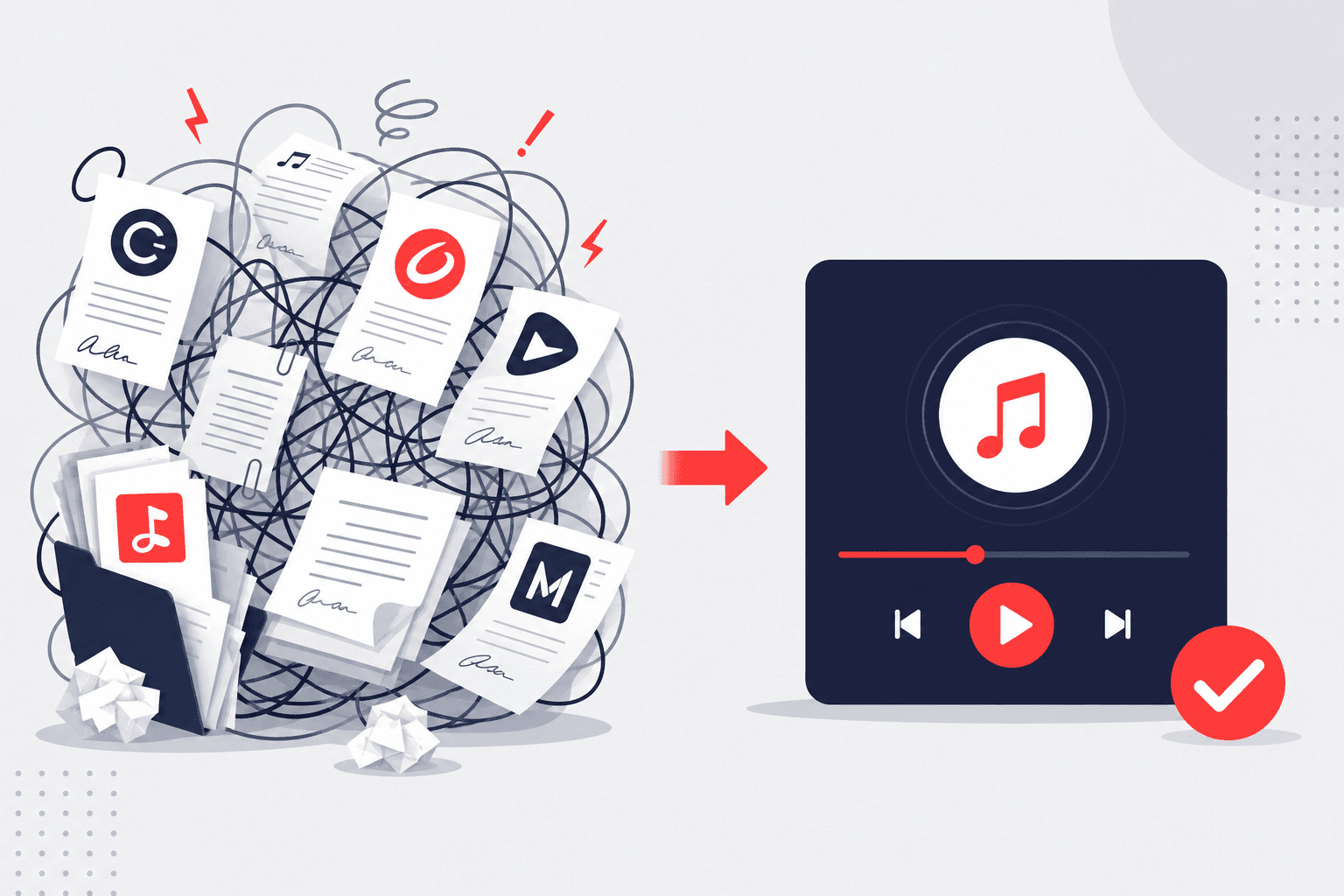
The complexity of traditional music licensing is exactly why services like 4Play were created. Here's how a direct-licensing model eliminates the compliance headache:
Single Point of Accountability
Instead of managing relationships with 2-3 different organizations, you have one subscription with one provider. 4Play handles all the rights directly, so you don't have to.
Built-In Legal Protection
Every song in the 4Play catalog is fully cleared for commercial use. There's no guesswork about whether a particular track is covered - if it's in the player, you're authorized to play it.
No Reporting or Paperwork
Traditional licenses often require you to report what was played and when. With 4Play, there are no reporting requirements. Play whatever you want from the catalog, whenever you want, without tracking anything.
No Inspections to Worry About
Since your license comes directly from the service that provides the music, there are no third-party organizations that need to verify your compliance. Your subscription is your proof of licensing.
Transparent, Predictable Costs
No variable fees based on square footage, seating, or operating hours. No annual negotiations. Just a fixed monthly subscription that covers everything.
A Practical Compliance Checklist
If you're a business owner who currently plays music (or plans to), here's a step-by-step checklist to ensure you're compliant:
Step 1: Audit Your Current Music Setup
- What music sources are you currently using?
- Do you have any existing licenses or agreements?
- Are you using consumer streaming services for commercial playback?
Step 2: Understand Your Jurisdiction's Requirements
- Which organizations manage music rights in your market?
- What types of licenses are required for your business category?
- Are there any exemptions that might apply to your situation?
Step 3: Evaluate Your Options
- Calculate the total cost of traditional licensing (all required organizations + music source)
- Compare with all-inclusive services like 4Play
- Consider the administrative burden of each approach
Step 4: Choose the Simplest Compliant Path
For most businesses, the simplest and most cost-effective path is an all-inclusive licensed music service. You get great music, full legal coverage, business management tools, and significant cost savings - all with zero administrative overhead.
Step 5: Document Your Compliance
Keep a record of your music license or subscription. If anyone ever asks whether your music is properly licensed, you can show your 4Play subscription as proof of full commercial authorization.
The Bottom Line: Compliance Doesn't Have to Be Complicated
Music compliance has a reputation for being confusing and expensive. And with the traditional approach, it often is. But the emergence of direct-licensed business music services has fundamentally changed the equation.
With 4Play, compliance is as simple as subscribing. You get:
Music should enhance your business, not create legal headaches. Choose a solution that lets you focus on what matters - your customers, your brand, and your business.
Try 4Play free for 7 days and experience what hassle-free music compliance looks like.
Ready to try?
No credit card, no commitment - just professional music for your business