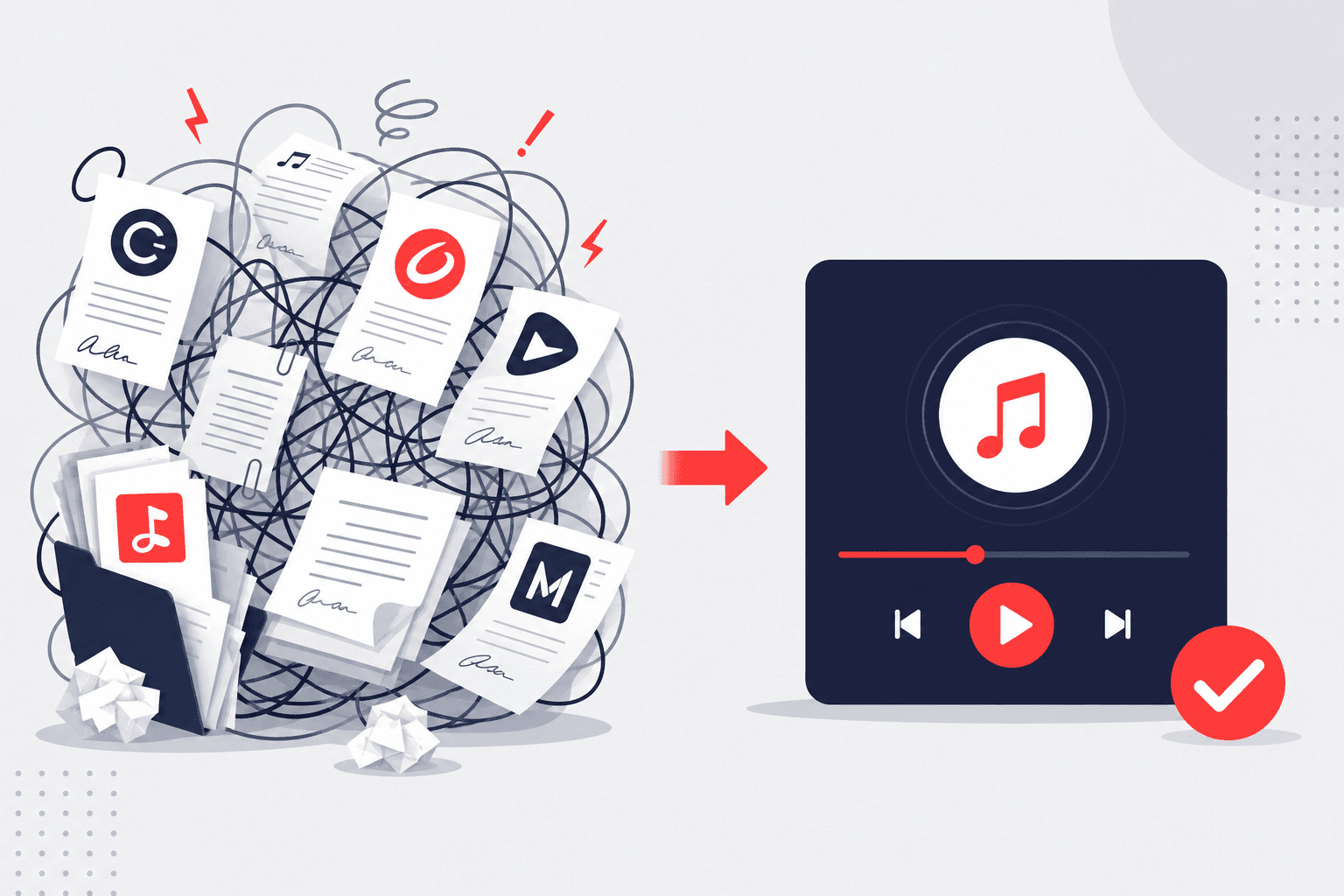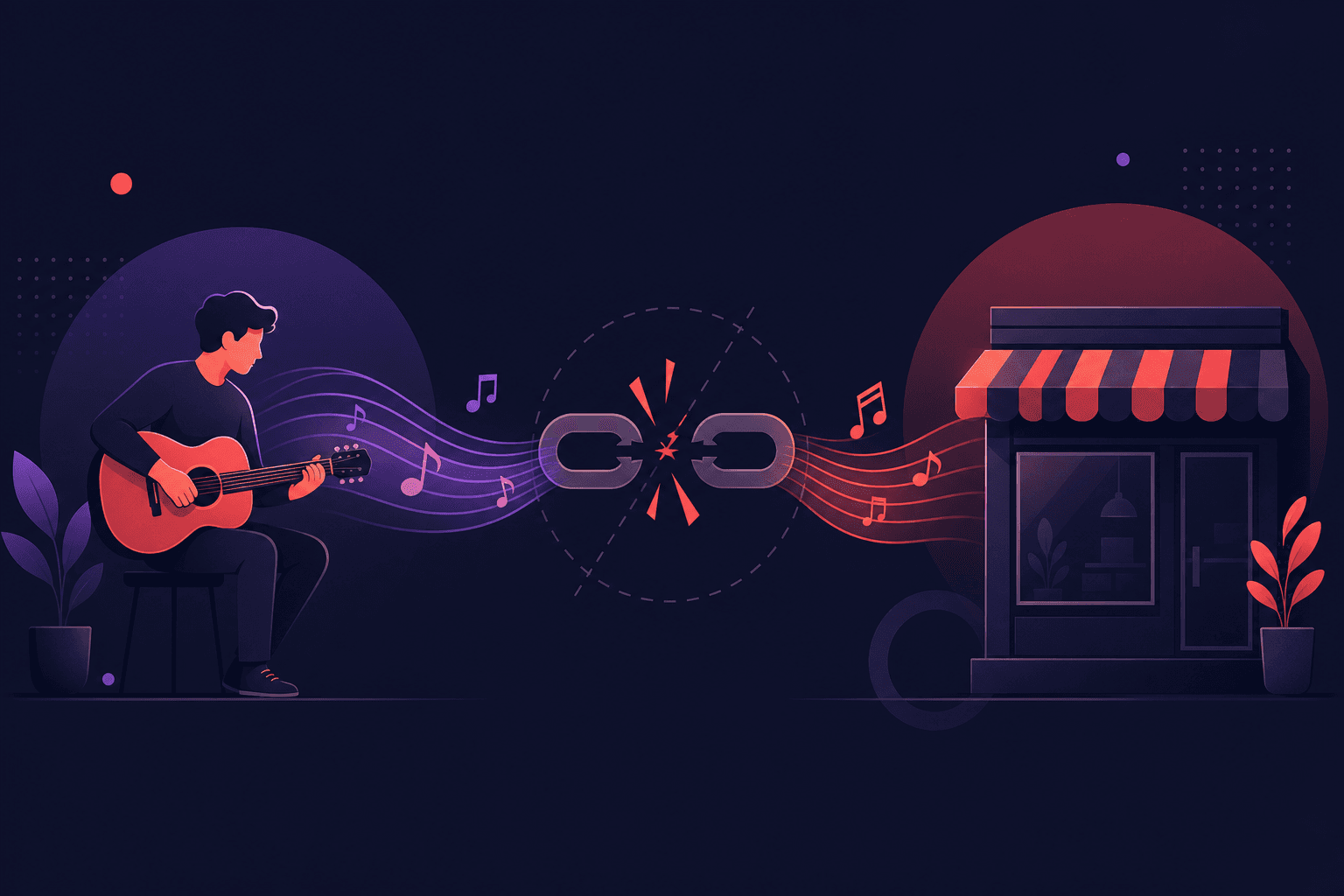

You've probably heard the term Royalty-Free Music and wondered: if it's "free of royalties," does that mean nobody gets paid? How can high-quality music be created if no one earns anything from it?
The short answer: someone always pays. The term "royalty-free" is one of the most misunderstood concepts in the music industry - and in this article, we'll break it down once and for all.
The "Food Chain" of a Song: Who Gets Paid?
Before we talk about payment models, it's important to understand just how many people are involved in creating a single song:
Every single one of these people is a professional who earns a living from their craft. Music doesn't "create itself" - and even when AI is involved, there are talented humans curating, directing and refining every track.
Behind every song you hear in a coffee shop, a hotel lobby or a clothing store, there's a team of creative professionals who poured hours of work into it.
Busting the Myth: "Royalty-Free" ≠ Free Music
Let's get this out of the way immediately: Royalty-Free does not mean the music is free. It's a payment structure term, not a value statement about the music.
What it actually means is: you pay once (or through a subscription), and you don't owe additional per-play royalties to collecting societies. That's it. Every person in the creation chain still gets paid - just through a different, more efficient model.
Think of it like buying a stock photo: you pay for the license, and then you can use it as many times as you want without paying per impression. The photographer still earned money.
The Traditional Route vs. Direct Licensing
The Traditional Route: Collecting Societies
Traditionally, when a business plays music publicly, here's how the money flows:
Business pays → Collecting society → Administrative fees deducted → Partial payment reaches artists (eventually)
Performing rights organizations and copyright collecting societies act as intermediaries between businesses and artists. They collect fees from businesses and - after deducting administrative costs - distribute payments to rights holders.
The problems with this model:
The Direct Route: How 4Play Works
With direct licensing, the money flows much more efficiently:
Business pays 4Play → 4Play pays artists directly → Done.
We work directly with artists, producers and music creators. We pay them upfront or through direct agreements - no middleman, no bureaucracy, no delays. The business gets a "clean" license that covers everything, and the artists get fair, transparent compensation.
This is the core meaning of "royalty-free" in our context: you don't need to pay any additional body beyond your 4Play subscription. Not because nobody deserves payment - but because we've already taken care of it.
So How Do I Know What I'm Allowed to Play?
We made it really simple - this is where the technology does the work for you.
All the music licensed for business use under a 4Play license is available right inside our platform. You don't need to check licenses, search for approvals, or wonder whether a specific song is allowed. Every song in the 4Play player is licensed for your business.
You have several ways to find the perfect music:
The simple rule: as long as you're playing music from the 4Play player - all music rights are included in your subscription.
Legal Freedom: Sleep Well Without "Play Reports"
One of the biggest practical advantages of the direct licensing model is the elimination of bureaucratic overhead:
With 4Play, the license is truly "all-inclusive." Play the full 4Play catalog with all rights included in your subscription.
Quality: This Isn't Cheap "Elevator Music" Anymore
There's an outdated stigma that royalty-free music is low-quality, generic background noise. That was true 15 years ago. It's not true anymore.
In today's world, with professional home studios, advanced production tools and AI-assisted creation, royalty-free tracks are produced at chart-level quality. If you played a royalty-free track from 4Play's library next to a song from a major label, most listeners couldn't tell the difference.
Our library includes over 100,000 tracks across every genre - from deep house and lo-fi to classical jazz, ambient and pop. All professionally produced, all fully licensed.
Music Copyright in the Age of AI
Can a Business Play AI-Generated Music?
This is one of the hottest debates in the music industry today. The legal landscape around AI-generated music is still evolving, and there's genuine uncertainty:
For a business owner, this ambiguity is a risk. Playing AI music from an unverified source could mean unclear legal standing.
Does 4Play Use AI-Generated Music?
Yes - and we embrace it fully. Our entire platform is AI-powered, and we work with dozens of artists who create music using AI tools.
But here's the key distinction: we deliberately say "artists," not "AI." Anyone can type a prompt and get a nice-sounding clip. But creating a complete, professional-quality music production that's suitable for businesses, promotes sales and doesn't drive customers away - that's an art form.
Our AI-artist creators are skilled professionals who understand music theory, production techniques and - crucially - what works in a business environment. They use AI as a powerful tool, the same way a photographer uses Photoshop or a filmmaker uses CGI.
Because we work directly with these artists and have clear licensing agreements, all music rights are included in your subscription - regardless of how the music was created.
The Artist's New Economic Model
Why would artists choose this model over the traditional route? The answer is simple economics:
The Traditional Model for Artists
- Create music → release through a label or independently → register with collecting societies → wait for airplay, streaming plays → receive fractions of a cent per play → wait months for payment
The reality: most independent artists earn less than $0.003 per stream on platforms like Spotify. An artist needs roughly 350,000 streams to earn a single month's minimum wage.
The Direct Model (with 4Play)
- Create music → license directly to 4Play → receive fair, upfront payment → focus on creating more music
No waiting, no uncertainty, no fractions of a cent. Artists get honest, direct compensation for their work, which allows them to sustain their creative career.
Summary: Transparency as a Core Value
When a business chooses 4Play, it's not just saving money - it's making a statement:
"Royalty-free" doesn't mean "nobody gets paid." It means the payment is built into a smarter, fairer system - one that's better for businesses, better for artists, and better for the music itself.
Ready to try?
No credit card, no commitment - just professional music for your business